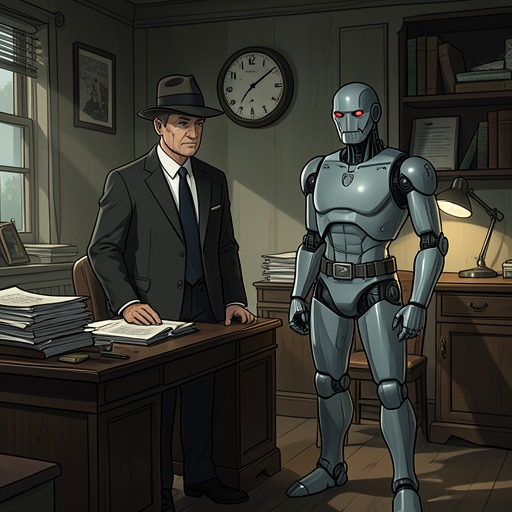
Roj Sarton’s murder
The Caves of SteelRoj Sarton’s murder is the case that brings Elijah Baley into a conflict extending well beyond a single death. A Spacer is found killed by a blaster, but the investigation is immediately shaped by New York’s jurisdiction, Spacetown’s extraterritorial rights, pressure from the Outer Worlds, and uncertainty about what evidence can be accepted.
The killing and its immediate revelation
The Commissioner tells Elijah Baley that a Spacer died three days earlier. Baley initially answers with sarcasm about disease, reflecting the known contrast between the Spacers’ protection from illness and Earth’s disease-ridden population. The Commissioner then clarifies that the death was a murder: the victim had been killed with a blaster. Baley’s response changes sharply; the news has transformed what sounded like a report of illness into a major criminal case.
The victim is identified as Roj Nemennuh Sarton, a citizen of Aurora and resident of Spacetown. When Baley begins discussing the investigation with his Spacer partner, R. Daneel Olivaw, he learns that the Spacers do not regard the murder as an isolated incident. They connect it to recent attempts to sabotage a Spacer-backed project to convert Earth toward an integrated human-and-robot society modeled on the Outer Worlds, and suspect a well-organized terrorist group. That connection broadens the case from an individual killing into a possible attack on a political project.
Jurisdiction and political stakes
The murder occurred within New York’s city limits, so the Terrestrial Bureau of Investigation maintains that the case belongs to the city. Spacetown, however, has extraterritorial rights. The Spacers can insist on conducting their own investigation and can report their conclusions to their home governments, creating a conflict between local authority and Spacer power rather than a straightforward division of legal responsibility.
The Commissioner has spent the three days after the killing in conferences with the Mayor, at Spacetown, and in Washington with the Terrestrial Bureau of Investigation. He describes the consequences of mishandling the case as potentially severe: the Outer Worlds could use the murder to demand indemnity, while agreeing to pay could be political suicide for the White House and refusing could carry a different kind of danger. The case therefore threatens to turn a city investigation into an interstellar dispute.
A negotiated investigation
The Spacers agree not to report the murder and to leave the investigation in Earth’s hands, but only on the condition that one of their own agents participate throughout. The Commissioner asks Baley to accept a Spacer partner. He acknowledges the mistrust implicit in the condition but also recognizes why the Spacers would insist on oversight if the investigation could bring trouble upon them with their governments. The partnership is thus not merely procedural: it is the compromise that allows the local investigation to proceed without immediately surrendering the case to the Spacers.
The false crime and the evidence problem
The inquiry later confronts a decisive reversal: the apparent killing of Sarton was staged. Baley accuses the Spacer scientists of using R. Daneel Olivaw to impersonate Sarton in a false murder and then using Sarton to impersonate R. Daneel in a false investigation. He argues that this scheme would let them control both the apparent victim and the investigation, and warns that Earth’s government could expose it to the Spacer authorities.
The dispute also turns on the status of a potential witness. R. Daneel Olivaw can distinguish faces even when Baley considers the circumstances too blurred for a human witness to remember them reliably. Baley counters that, if R. Daneel identifies himself as a robot, Earth courts will not treat him as a legally recognized witness. The murder case thus exposes a gap between what a robot may know and what the law will accept as evidence, leaving the pursuit of truth constrained by political jurisdiction and legal standing as well as by the facts of the crime.